
PCM vs PCB vs PCMB: How to Choose the Right Science Stream in Class 11
The short answer: choose PCM if your child enjoys Maths and is aiming for engineering, architecture, the Air Force or Navy, or data careers. Choose PCB if they are drawn to medicine, allied health or life sciences. Consider PCMB only if they are strong in both Maths and Biology, still undecided between the two paths, and ready for a noticeably heavier workload. The rest of this guide explains the subjects, careers, entrance exams and a simple 4-step framework to help you decide with confidence.
What Are PCM, PCB and PCMB Streams in Class 11?
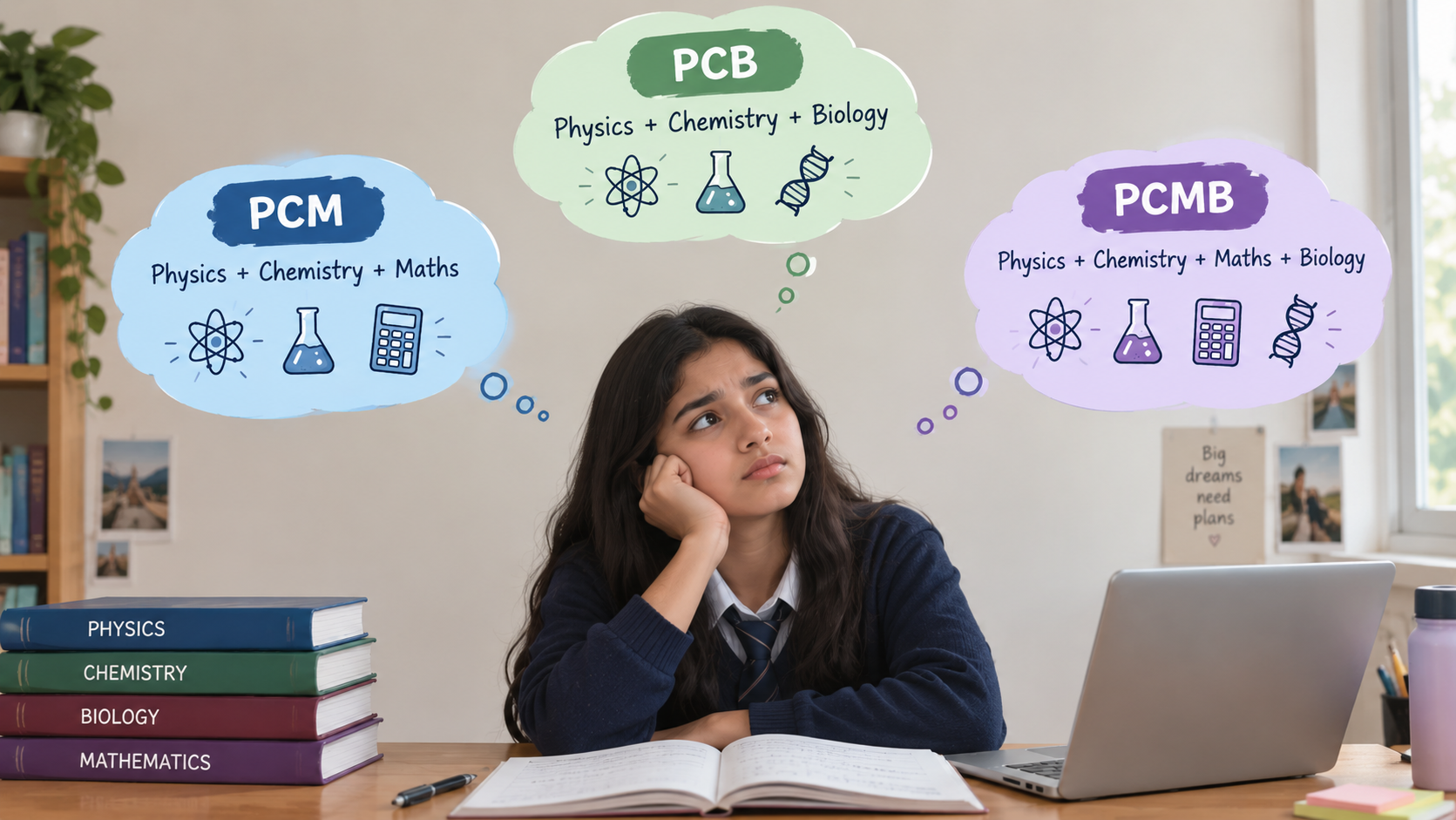
Moving from Class 10 to Class 11 is one of the most important decisions in a student's school life. In CBSE and ICSE schools, the Science stream splits into three main subject combinations:
-
PCM (often called Non-Medical): Physics, Chemistry and Mathematics, plus English and an elective such as Computer Science, Physical Education or Economics.
-
PCB (often called Medical): Physics, Chemistry and Biology (Botany and Zoology), plus English and an elective such as Psychology, Biotechnology or Fine Arts.
-
PCMB: Physics, Chemistry, Mathematics and Biology, plus English. It keeps both the engineering and the medical routes open for longer.
Class 10 Science is broad and largely factual. Class 11 goes much deeper: abstract Physics, organic Chemistry, detailed human and plant physiology, and new Maths topics such as functions, trigonometry and an introduction to calculus. One thing parents often miss: calculus is only a small part of Class 11 Maths, carrying 8 of 80 theory marks in the CBSE 2025-26 syllabus, but it becomes the largest unit in Class 12 at 35 of 80 marks. A child who finds Class 11 Maths "just about manageable" should expect it to get harder, not easier, the following year.
When you weigh the options, look at how your child handled their Class 10 board exam preparation: did they enjoy working through multi-step problems, or were they more comfortable with concepts, diagrams and detailed explanations?
 What Career Options Open Up with PCM, PCB and PCMB?
Mapping careers early helps you match Class 11 subjects to your child's long-term goals. Here is what each stream leads to, along with the eligibility rules that matter.
Careers with PCM
-
Engineering and technology: B.Tech/B.E. in Computer Science, Artificial Intelligence, Electronics, Mechanical, Civil and Aerospace through JEE Main and JEE Advanced. For B.Tech admission through JEE Main, Physics and Mathematics are compulsory in Class 12, and NITs, IIITs and GFTIs also require 75% in Class 12 (65% for SC/ST) or a place in the top 20 percentile of the board. Read more in our guide on how to get into engineering.
-
Architecture: B.Arch through NATA or JEE Main Paper 2. The Council of Architecture requires Physics, Chemistry and Mathematics in Class 12 with at least 50% in PCM and 50% overall.
-
Defence and aviation: the NDA Air Force and Naval wings require PCM in Class 12, while the Army wing is open to any stream. To get a Commercial Pilot Licence, the DGCA requires Physics and Mathematics in Class 12; students from other streams can clear them later through NIOS.
-
Pure sciences and analytics: B.Sc/B.S. in Mathematics, Physics, Statistics, Data Science and Actuarial Science. See also our guide to AI careers for students.
Careers with PCB
-
Medicine and dentistry: MBBS, BDS, BAMS, BHMS and Veterinary Science, with admission largely through NEET-UG. Competition is intense: about 22.09 lakh candidates appeared for NEET-UG 2025, while India had 1,24,825 MBBS seats across 809 medical colleges in 2025-26.
-
Allied health sciences: Physiotherapy (BPT), Nursing, Radiology, Medical Laboratory Technology and Occupational Therapy.
-
Life sciences and biotechnology: B.Sc in Biochemistry, Genetics, Microbiology, Molecular Biology and Forensic Science. Explore more in Biology careers beyond MBBS.
-
Pharmacy: B.Pharm and Pharm.D. Under Pharmacy Council of India rules, both PCM and PCB students are eligible, since Physics and Chemistry are compulsory with either Maths or Biology.
Careers where PCMB gives an edge
Some interdisciplinary fields draw on both Maths and Biology. PCMB is not mandatory for most of them, and many courses admit PCM students, but having both subjects makes the transition smoother:
-
Biomedical engineering: designing prosthetics, medical devices and diagnostic equipment.
-
Bioinformatics and computational biology: analysing genetic and health data with programming and machine learning.
-
Agricultural technology and biophysics: climate-resilient crops, synthetic biology and biomechanics.
How Do PCM, PCB and PCMB Compare?
Here is a side-by-side view to help you compare the three options objectively:
|
PCM |
PCB |
PCMB |
|
|---|---|---|---|
|
Core subjects |
Physics, Chemistry, Maths |
Physics, Chemistry, Biology |
Physics, Chemistry, Maths, Biology |
|
Main skills used |
Numerical problem-solving, logic, calculus |
Conceptual understanding, detailed recall, diagrams |
Both, in full |
|
Key entrance exams |
JEE Main, JEE Advanced, BITSAT, NATA, CUET |
NEET-UG, CUET |
Eligible for both JEE Main and NEET-UG |
|
Practical work |
Physics and Chemistry labs |
Physics, Chemistry and Biology labs |
All four lab subjects |
|
Overall workload |
Heavy |
Heavy |
Heaviest of the three |
|
Best suited to |
Students who enjoy Maths and want engineering, tech, architecture or defence |
Students drawn to medicine, health or life sciences |
Students strong in both who are still deciding, or aiming for interdisciplinary fields |
Is PCMB Worth the Extra Workload for Your Child?
Many parents choose PCMB as a "safety net" so their child does not close any doors too early. It can work, but it is worth understanding what it asks of a student.
The double-preparation challenge
JEE preparation is built on daily numerical problem-solving in Physics and Maths. NEET preparation leans heavily on a deep, line-by-line command of NCERT Biology alongside fast recall. A PCMB student who prepares for both exams splits their time between two very different styles of study, while competing against classmates who are giving all their time to just one. On top of that, they carry four lab subjects and their record books.
That does not make PCMB a bad choice. It makes it a choice that suits a specific kind of student: one who enjoys both subjects, is well organised, and is genuinely undecided rather than simply nervous about committing.
Two common scenarios
Scenario A: PCMB as a safety net. A student who did well in Class 10 but has no clear preference takes PCMB "just in case." By the middle of Class 11, the extra Biology practicals and Maths homework leave little time for revision or sleep, and test scores in both subjects begin to slip. The family ends up dropping one subject anyway, having lost several months.
Scenario B: A focused choice. A student with a clear interest in numbers chooses PCM with Computer Science. Without Biology practicals and memorisation, they spend that time on Physics and Maths problem-solving and go into Class 12 with stronger foundations and less stress.
The lesson is not "avoid PCMB." It is that PCMB should be an active choice backed by interest and capacity, not a way to postpone the decision.
How Can You Decide Which Stream Fits Your Child Best?
Rather than following peer pressure or trends, work through these four steps before you fill in the Class 11 form. Our guide on how to pick your stream after Class 10 covers the Commerce and Arts options too.
Step 1: Check aptitude and interest
Look at how your child responds to each subject day to day, not only at their marks:
-
Maths: do multi-step algebra or geometry problems energise them, or do they avoid them? If Maths causes regular dread now, PCM will feel harder in Class 12 when calculus takes over.
-
Biology: do they enjoy understanding how living systems work, and can they stay with detailed material? Class 11 Biology means learning many scientific terms, processes and classifications thoroughly.
Step 2: Be honest about workload
PCMB means four lab subjects plus English, and often coaching on top. If your child already struggles to fit in sleep, revision and downtime, a focused PCM or PCB combination is usually the healthier choice.
Step 3: Match the stream to the target exam
|
If your child... |
Consider |
|---|---|
|
Enjoys Maths more than Biology and is leaning towards engineering, architecture, defence or data |
PCM |
|
Enjoys Biology more than Maths and is leaning towards medicine, health or life sciences |
PCB |
|
Is strong in both, enjoys both, and is aiming for an interdisciplinary field or is genuinely undecided |
PCMB, with a plan to review it within the first term |
|
Has no clear direction yet |
Start with the AI Career Predictor, then talk to a counsellor before deciding |
Step 4: Get an expert opinion if you are still stuck
If your family is still torn, speak with an experienced counsellor who can look at your child's marks, interests and learning style together. You can book a 1-on-1 academic counselling session with Paathshala before school admissions close.

Still Unsure? Let Paathshala's AI Career Predictor Point the Way
If your child is still torn between PCM, PCB and PCMB, start with what they enjoy and where they do well, not with what their friends are choosing. Paathshala's AI Career Predictor is built for exactly this moment. Your child answers a short set of questions about their interests, favourite subjects and the kind of work that excites them, and the tool maps those answers to suitable career paths and the stream that leads to each one.
Use the result as a starting point for a conversation at home. If it leans towards engineering, technology or design, PCM is the natural fit. If it points to healthcare, research or life sciences, PCB makes more sense. If it highlights interdisciplinary fields like biomedical engineering or bioinformatics, PCMB may be worth the extra workload. And if you would like an expert to go through the results with you, you can book a 1-on-1 session with a Paathshala career counsellor.
Conclusion: Choose the Stream That Fits Your Child, Not the Crowd
Choosing between PCM, PCB and PCMB is not about picking the "safest" option. It is about matching the stream to how your child thinks, what they enjoy and where they want to go. PCM suits students who like numbers, logic and problem-solving and who are drawn to engineering, technology, architecture or defence. PCB suits students who are curious about living systems and ready for steady, detailed study on the way to medicine, allied health or life sciences. PCMB keeps both doors open, but works best for students who are strong in both Maths and Biology and can handle a much heavier weekly workload.
Before you fill in the Class 11 form, look beyond Class 10 marks: check your child's comfort with Maths, their appetite for Biology, and the entrance exam they are aiming for. Talk it through together, and get an expert view if you are still unsure. The right stream makes Class 11 and 12 challenging rather than overwhelming, and that confidence shows up in both board results and entrance exams.
Frequently Asked Questions About Class 11 Stream Selection
1. Can a student take NEET after studying PCM with Biology as an additional subject?
Yes. Under a June 2023 decision by the National Medical Commission, candidates who pass Biology or Biotechnology as an additional subject, including after completing Class 12, are eligible to appear for NEET-UG. NEET-UG 2024 was the first exam where this applied. Always check the current NTA information bulletin before applying.
2. Is PCMB too difficult for an average student?
There is no official marks cut-off for choosing PCMB. As a practical guide, it suits students who are consistently strong in both Maths and Science, enjoy both, and manage their time well. If high Class 10 scores came only with heavy tutoring, or if your child already feels stretched, a focused PCM or PCB combination is usually the better choice.
3. Which stream has better salary potential: PCM or PCB?
Both lead to well-paid careers, but on different timelines. Many PCM graduates in fields such as software, data and finance start earning after a 4-year degree. Doctors usually spend longer in training (MBBS followed by a postgraduate degree), so their peak earnings tend to come later, along with strong long-term stability. Interest and aptitude matter more than salary tables, because students do best in fields they enjoy.
4. Can a PCB student switch to engineering later?
It is harder. Most B.Tech admissions through JEE Main require Physics and Mathematics in Class 12. PCB students who want to keep engineering open can take Maths as an additional subject (for example through NIOS) and check the latest NTA rules, or look at courses such as B.Tech Biotechnology at universities that admit PCB students. Rules vary by university, so check each one before applying.
5. Can a PCM student study pharmacy?
Yes. Pharmacy Council of India rules allow both PCM and PCB students to apply for B.Pharm.
6. What if my child is completely undecided after Class 10?
Taking PCMB at the start of Class 11 can act as a short trial period, but only if your school allows students to drop Maths or Biology later in the year. Policies differ, so ask the school about its deadline for subject changes before you register. Meanwhile, use the AI Career Predictor and a counselling session to reach a clearer decision within the first term, rather than carrying five heavy subjects for two years by default.