
Why Secularism Still Matters in Today's World
Secularism is often thrown around as a political term, debated on television, or written about in textbooks. But for many of us, its meaning and importance only hit home when we imagine being in someone else’s shoes. Picture yourself as a Hindu or Muslim living in a town in the United States where Christian fundamentalism dominates. You’re a citizen of that country, yet people refuse to rent a house to you just because of your religion. When you raise your voice against this unfairness, someone responds, “Go back to India.” That moment of humiliation and rejection reveals exactly why secularism is more than a word—it’s a shield that protects human dignity and the idea of equal citizenship.
Secularism Is Not Anti-Religion
There’s a common misconception that secularism is anti-religion or a rejection of faith. In truth, secularism is deeply committed to protecting the right of every individual to practice—or not practice—any religion of their choice. It is not about removing religion from society, but about making sure religion does not become a tool for power, oppression, or division. It ensures that the government treats all citizens equally, regardless of their beliefs, and does not promote or favor any one religion over others. At its core, secularism is about fairness, justice, and the right to live without fear of being discriminated against for one's faith.
The Danger of Mixing Religion with Power
History offers several powerful examples of what can go wrong when religion and State power mix. In Hitler’s Germany, Jews were persecuted and millions were killed in one of the worst genocides in history. Ironically, today in Israel—created as a refuge for Jews—Muslim and Christian minorities often face harsh treatment. In Saudi Arabia, non-Muslims are not allowed to build temples or churches or pray publicly. These are not isolated cases; they are reminders of what happens when religion is given official state power. The result is usually discrimination, exclusion, and the denial of basic human rights to those who do not belong to the dominant religion. This is precisely what secularism seeks to prevent.
India’s Unique Approach to Secularism
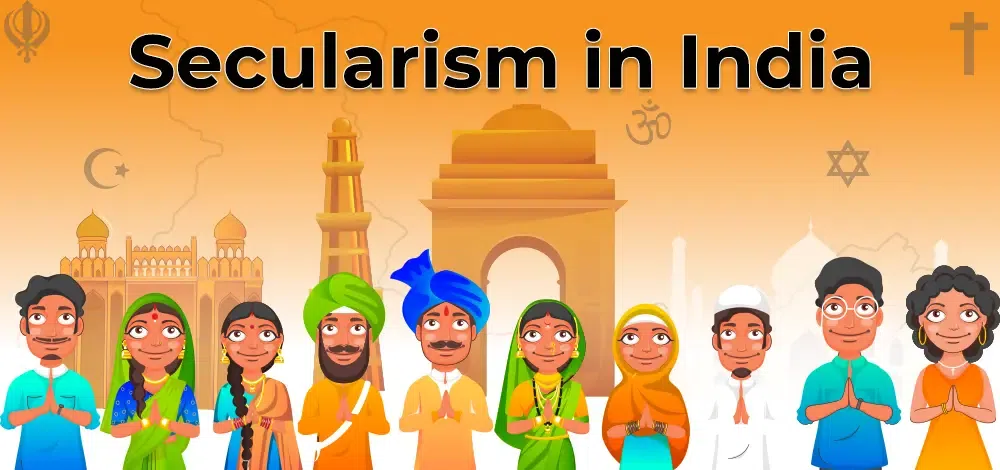
India is one of the most religiously diverse countries in the world, and the framers of the Indian Constitution knew that such diversity needed to be protected. That’s why secularism was included as a core principle. However, Indian secularism differs from Western models like that of the United States, where there is a complete separation between religion and State. In India, the State does not completely isolate itself from religion. Instead, it maintains what is called a “principled distance,” which allows it to engage with religion when necessary—especially to ensure justice and equality.
In India, the State does not officially support any religion. Government schools and offices are not supposed to promote religious practices. At the same time, the State also recognizes the importance of certain religious customs. For example, Sikh men are not required to wear helmets while riding two-wheelers because wearing a turban is a central part of their faith. This balance—of not favoring any religion, but also respecting them—is the foundation of Indian secularism.
When the State Must Intervene
There are times when religious practices cause harm or violate the rights of others. In such cases, the Indian State does not hesitate to intervene. A key example of this is the abolition of untouchability—a practice rooted in caste discrimination within Hinduism. Though it was considered a religious tradition by some, the Constitution rightly recognized it as an inhuman practice that had to be ended in the name of justice and equality. Similarly, the government may intervene in religious personal laws, like those concerning inheritance or marriage, if they conflict with fundamental rights. This kind of intervention is not against religion but is meant to ensure that religion does not become a shield for injustice.
Secularism in Practice: The Challenges We Face
Even though the Indian Constitution provides strong protections for religious freedom and equality, violations still occur in daily life. There are places where people are denied homes because of their religion. There are moments when political groups try to divide people along religious lines. There are times when someone is told not to pray, or worse, attacked for how they pray. These are moments when secularism is most needed—not as a lofty principle, but as a practical defense of human rights. The very fact that such incidents still happen is proof that secularism is not outdated. On the contrary, it is urgently relevant.
The Bigger Picture: Secularism Protects Everyone
ecularism is not only for religious minorities. It benefits everyone, including the majority. It ensures that no one group can use religion as a weapon to dominate others. It protects the right to believe, to question, and even to change one’s beliefs. Without secularism, democracy itself would be in danger. When one religion takes control, freedom shrinks—not just for others, but even for those within the majority who think differently.
A Call for Awareness and Action
As citizens, it’s important for us to be aware of what secularism really means and why it matters. It’s easy to dismiss it as a political issue or something only minorities care about. But the truth is, secularism is about justice and equality for all. It reminds us that no one should be forced to choose between their faith and their rights. It gives us the power to stand up against discrimination, whether it happens in a courtroom, a classroom, or our own neighborhoods.
The next time you see someone being mistreated because of their religion, remember: you can stay silent, or you can stand for something bigger. That choice—to speak up for justice and equality—is what keeps secularism alive. And in today’s world, that might just be the most important choice of all.


.jpg)