
Feeling the Heat: Dive into Temperature and Heat
Have you ever puzzled why a hot cup of cocoa warms your hands but frozen water makes them shiver? It is all about heat and temperature! Let's investigate these ideas with some fun activities and simple explanations.
Temperature: The "Hotness" Meter
Consider temperature as a measure of how "excited" the small particles inside an object are. The more they wriggle and jiggle, the hotter the thing becomes! We use thermometers to determine temperature. You've undoubtedly seen a clinical thermometer used to take your temperature while you're feeling ill. These thermometers are specifically built for the human body and often provide readings between 35°C and 42°C (95°F to 107.6°F).
Lab thermometers, on the other hand, are used for a variety of applications in research labs and can detect temperatures ranging from -10°C to 110°C.
Heat: Energy Transfer
Heat is a kind of energy that constantly flows from a hotter item to a cooler one. Imagine a hyperactive dog pursuing a slower one - heat energy is always on the go, attempting to balance things out!
Experiment 1: The Melting Ice Cube Race
Materials you Need : You'll need two ice cubes, a metal spoon (conductor), a plastic spoon (insulator), and two dishes.
What To Do: Place one ice cube in each basin. Place one ice cube on the metal spoon and another on the plastic spoon, with the spoons' other ends outside the bowls. See what happens!
What You'll See: The ice cube with the metal spoon melts quicker.
Why?Metal is an excellent thermal conductor, which means that heat may quickly move through it. The metal spoon transfers heat from the heated environment to the ice cube, causing it to melt quicker. Plastic is an insulator, which means it prevents heat from passing through readily.
Heat Transfer: The Three Musketeers
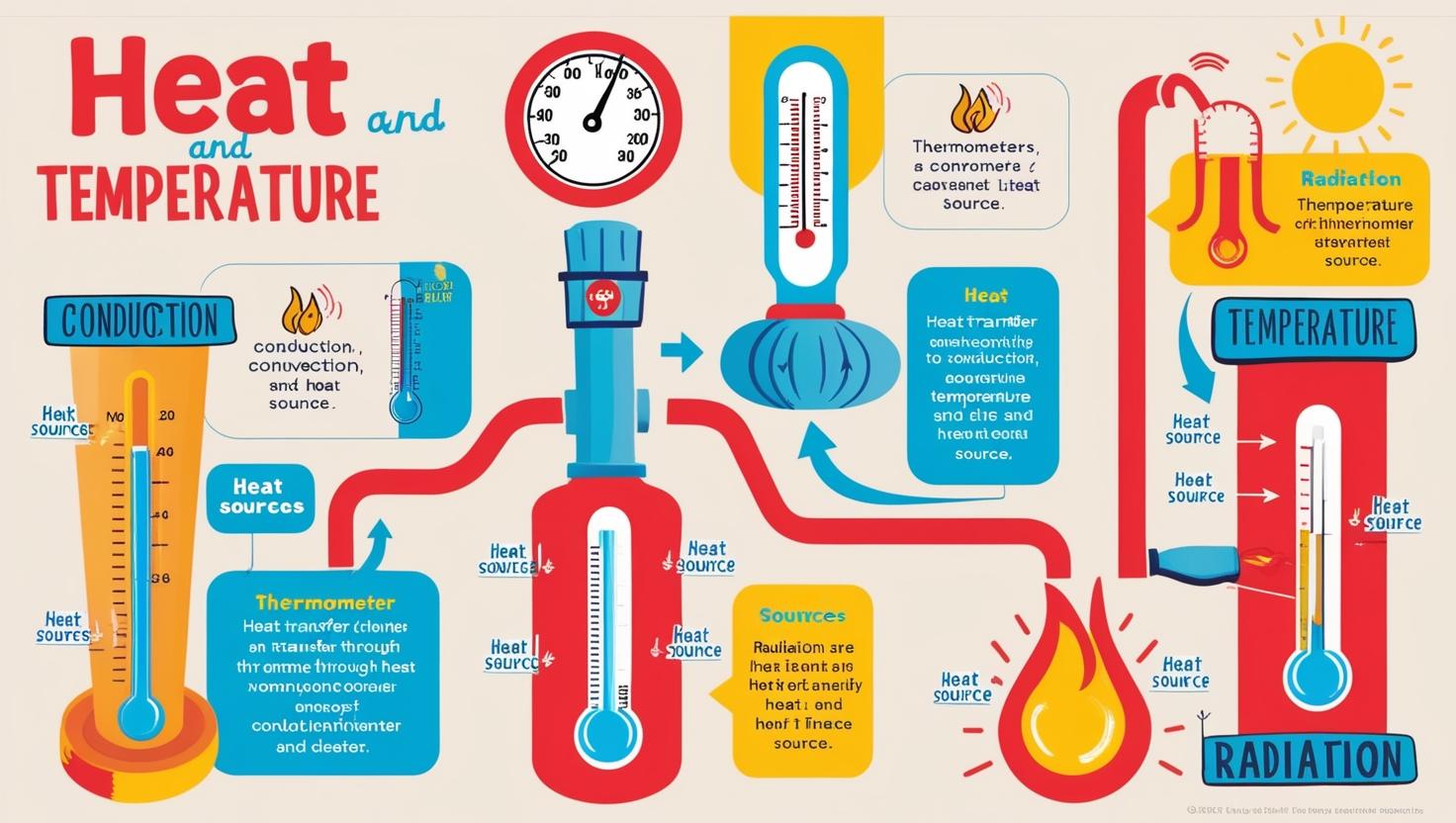
Heat may be transferred in three ways:conduction, convection, and radiation.
Imagine a line of dominoes. When you knock down the first one, the action (energy) travels down the line.
Conduction is comparable.Heat moves through a substance from the hotter end to the cooler end, much like dominoes passing on energy. This mainly occurs in solids.
Convection is analogous to boiling water. The heated water at the bottom rises while the chilly water at the top sinks. Convection refers to the circular movement of heat transmission. This happens in both liquids and gasses.
Radiation-Have you ever felt the sun's warmth on your skin? That is radiation! Heat moves across space without the need for any substance to transport it. It's how the sun's energy reaches us.
Experiment 2: The Colorful Absorbers
What you need: Two pieces of fabric - one light-colored (e.g., white), one dark-colored (e.g., black), and a sunny location.
What To Do:Place both clothes in the sun for approximately one hour. Then, carefully touch each cloth (be careful since they may be hot!).
How you will feel:The darker cloth will be hotter than the lighter cloth.
Why? Dark hues absorb more heat than lighter colors. To be cool during the summer, we generally wear light-colored clothing!
Woolly Warmth
Ever wondered why woolen sweaters keep us so warm in the winter? Wool is a poor heat conductor, which implies that heat cannot quickly escape from our bodies. It also traps air between its strands, and air is a far superior insulator! As a result, our body heat remains concentrated, keeping us warm and comfortable.
So there you have it. Heat and temperature are intriguing issues that reveal a great deal about our planet. Understanding heat transmission allows us to make informed decisions about what we wear, how we cook, and even how we construct our houses!