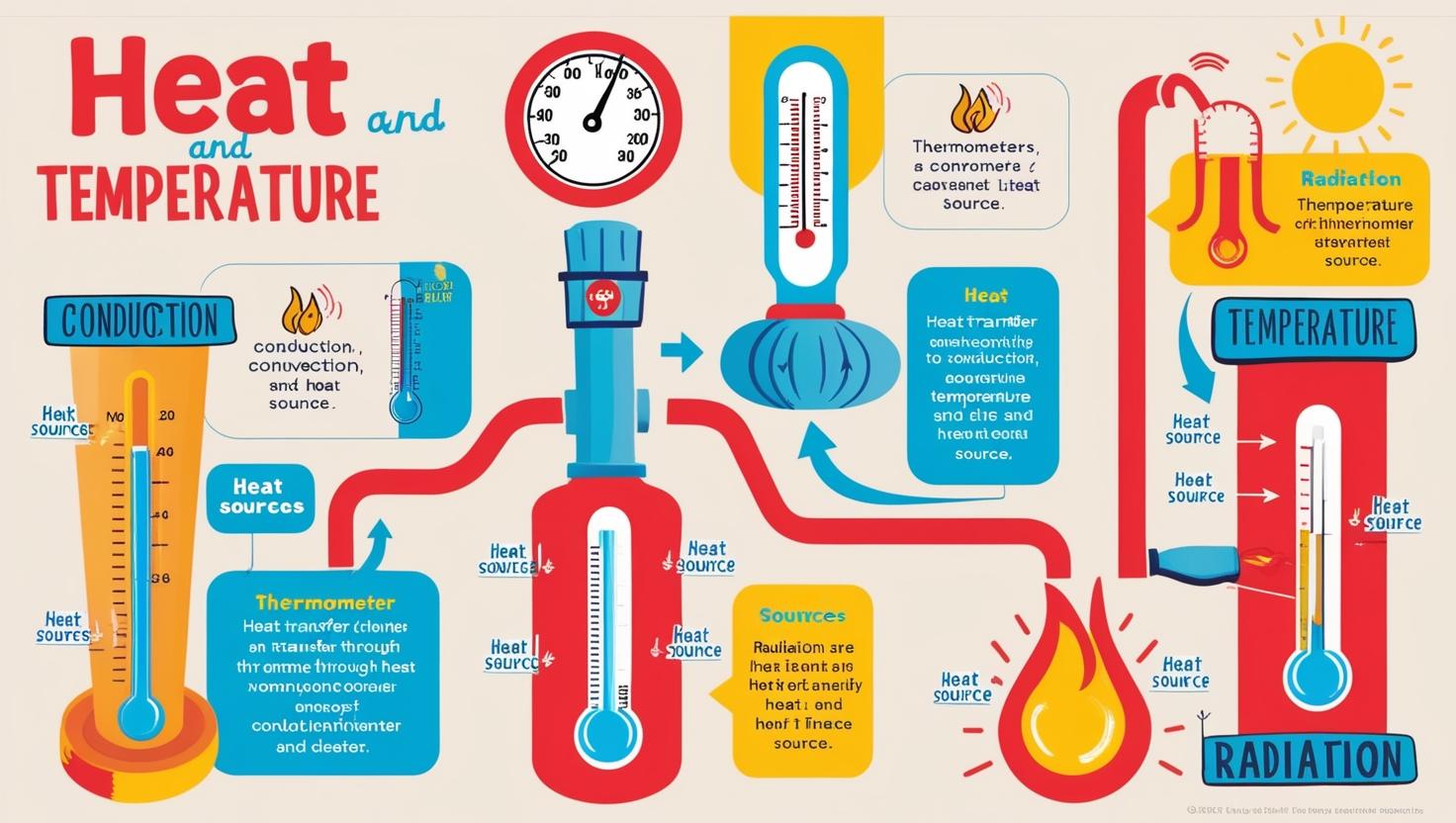


You must have heard people saying ‘Wear warm clothes, the temperature is very low’. Or ‘stay at home the temperature is very high.’ But what exactly is the temperature? Let's find out!
What is temperature?
Temperature is the measure of hotness or coldness of any solid, liquid, or gaseous substance around us.
Example: How does ice cream feel when you touch it? Cold, right? And what about a cup of hot chocolate? It feels hot, right? What makes them different is temperature.
Why is temperature important?
Now you know what temperature is, but why are we even measuring the temperature?
The reasons are many, but the major reason behind our measuring the temperature is:
- For monitoring health like checking body temperature to find out if you have a fever.
- For predicting weather conditions, like heat waves in the summer.
- For cooking food without spoiling, like we do when baking cake.
- For carrying out certain scientific experiments to avoid mistakes like the blasts you see in some cartoons.
- For manufacturing different products, by melting or freezing elements as needed.
How do we measure the temperature?
We measure temperature using a special tool called a thermometer. It tells us how hot or cold something is. It has a line or number that contains mercury that rises up when it's hot and goes down when it's cold.
Types of thermometers
There are mainly two types of thermometers we come across the most in our day-to-day lives. These are:
Clinical thermometer: You must have noticed your parents measuring fever with a thermometer that shows your body temperature when it comes in contact with your body. These thermometers are specifically used for measuring your body temperature.
Laboratory thermometer: This type of thermometer is the one you might find in your school laboratory. They are used in experiments for measuring high temperatures.
What are Units of Temperature?
Whenever we measure how hot or cold something is with a thermometer, we see numbers. These numbers need a 'name' or a 'label' to tell us how we measure them. This 'label' is called a unit of temperature.
Just like we use kilograms to measure weight or meters to measure height, we use units like Celsius, Fahrenheit, or Kelvin to measure temperature.
Celsius (°C)–
Celsius is the most commonly used unit in India and the world. You will mostly hear about temperature in your school, house, and weather reports in Celsius.
And guess what it's easy to remember because water freezes at 0°C and boils at 100°C.
Fahrenheit (°F)–
Fahrenheit is another unit to measure temperature. It is mostly used in some countries like the USA.
Fahrenheit scale is a bit different from Celsius, as on this scale water freezes at 32°F and boils at 212°F .
Kelvin (K)–
Kelvin is a unit used by scientists when they research topics like space or extremely cold temperatures.
Kelvin starts at 0 K, which is the coldest temperature possible, called absolute zero.
Conclusion
We have learnt everything about temperature from its meaning to its measurement through a thermometer. The types of thermometers and the units are some other things that we have learnt. So go try it out by measuring the temperature of your drinking water throughout the day and see if you find any difference.